

Introduction
In today’s fast-changing digital world, technology is shaping how we work, communicate, and live. From artificial intelligence and blockchain to cloud computing and cybersecurity, future tech skills are no longer optional—they’re essential.
Learning these skills not only opens doors to better career opportunities but also helps you stay competitive in an evolving job market. Whether you’re a student preparing for your future, a professional looking to upgrade your expertise, or an entrepreneur aiming to innovate, mastering future tech ensures you’re ready for the challenges ahead.
By investing in future tech skills today, you’re not just learning tools—you’re preparing to become a problem-solver, innovator, and leader in tomorrow’s world.
Top Future Tech Skills You Should Master
Artificial Intelligence & Machine Learning
Artificial Intelligence (AI) and Machine Learning (ML) are among the most in-demand skills shaping the future of technology. AI enables machines to mimic human intelligence, while ML allows systems to learn and improve from data without explicit programming.
From self-driving cars and voice assistants to fraud detection and personalized recommendations, AI and ML are already part of our daily lives. Companies across industries—finance, healthcare, retail, and education—are actively adopting these technologies to optimize processes and deliver smarter solutions.
Learning AI and ML equips you with skills such as:
- Data Analysis & Pattern Recognition – making sense of large datasets.
- Predictive Modeling – building systems that forecast future outcomes.
- Automation & Efficiency – creating solutions that save time and resources.
Professionals with expertise in AI and ML enjoy high-paying jobs, strong career growth, and opportunities to innovate in groundbreaking projects.
Technology for Blind People – Education to Daily Life
Tech News Top App – Stay Updated with Latest Tech Trends
Future Tech Solutions – Shaping the Digital Era
Data Science & Big Data Analytics
Data has become the “new oil” of the digital economy. Every click, transaction, and interaction generates valuable information, and organizations are increasingly relying on Data Science and Big Data Analytics to turn this raw data into meaningful insights.
Data Science focuses on extracting knowledge from structured and unstructured data using statistical methods, algorithms, and visualization tools. Big Data Analytics handles massive datasets that traditional tools can’t manage, enabling real-time decision-making at scale.
Key applications include:
- Business Intelligence – understanding customer behavior and market trends.
- Predictive Analytics – forecasting sales, risks, or operational challenges.
- Healthcare & Research – improving patient outcomes and medical innovations.
- Financial Services – detecting fraud and managing risks effectively.
For learners, mastering Data Science and Big Data means gaining skills in Python, R, SQL, Hadoop, and data visualization tools like Tableau or Power BI. With these, you can pursue careers as data analysts, data scientists, big data engineers, or business intelligence experts—roles that are highly paid and in growing demand.
Cybersecurity & Ethical Hacking
As technology grows, so do cyber threats. From data breaches to ransomware attacks, businesses, governments, and individuals are at constant risk. Cybersecurity has become a top priority to safeguard sensitive information, financial assets, and digital infrastructure.
Ethical Hacking plays a key role in this domain. Unlike malicious hackers, ethical hackers use their skills to identify vulnerabilities in systems, networks, and applications—helping organizations fix weaknesses before cybercriminals exploit them.
Why These Skills Matter
- Rising Threats: Cybercrime damages are expected to cost the world trillions of dollars annually.
- High Demand: Skilled cybersecurity professionals are among the most sought-after tech experts.
- Critical for All Sectors: Banking, healthcare, government, and e-commerce all rely on robust security systems.
Career Opportunities
Learning cybersecurity and ethical hacking opens career paths such as:
- Security Analyst
- Penetration Tester
- Cybersecurity Consultant
- Incident Response Specialist
By mastering these skills, you don’t just protect data—you become a digital guardian in an increasingly connected world.
Cloud Computing & DevOps
In today’s digital economy, businesses are shifting from traditional IT infrastructure to cloud-based solutions for flexibility, scalability, and cost savings. Cloud Computing allows organizations to store, manage, and process data on remote servers, making services accessible anytime, anywhere. Leading platforms like AWS, Microsoft Azure, and Google Cloud are driving this revolution.
On the other hand, DevOps bridges the gap between development and operations teams. It emphasizes automation, continuous integration (CI), and continuous delivery (CD) to speed up software deployment and ensure higher-quality applications. Together, Cloud and DevOps enable businesses to innovate faster and deliver seamless digital experiences.
Key Benefits
- Scalability & Flexibility: Easily expand or reduce resources as needed.
- Automation: Streamline repetitive tasks, saving time and reducing errors.
- Cost Efficiency: Pay only for what you use, lowering infrastructure costs.
- Faster Delivery: Continuous deployment enables quicker software releases.
Career Opportunities
By mastering Cloud Computing and DevOps, learners can pursue roles such as:
- Cloud Engineer
- DevOps Engineer
- Site Reliability Engineer (SRE)
- Cloud Architect
These roles are among the most in-demand and high-paying in the tech industry, making them essential skills for the future.
Blockchain & Web3 Technologies
Blockchain is more than just the foundation of cryptocurrencies—it’s a secure, transparent, and decentralized system for recording transactions. Unlike traditional databases, blockchain ensures data integrity by making records immutable and verifiable across distributed networks.
Building on this, Web3 represents the next phase of the internet—an ecosystem where users have more control over their data, digital identities, and online interactions. Web3 is powered by blockchain, smart contracts, decentralized applications (dApps), and token-based economies.
Real-World Applications
- Finance (DeFi): Peer-to-peer lending, decentralized exchanges, and digital wallets.
- Supply Chain Management: Transparent tracking of goods from production to delivery.
- Healthcare: Secure sharing of patient records across systems.
- Digital Ownership: NFTs and decentralized content creation.
Career Opportunities
By learning Blockchain and Web3, you can explore roles like:
- Blockchain Developer
- Smart Contract Engineer
- Web3 Product Manager
- Crypto Analyst
As industries embrace decentralization, expertise in Blockchain and Web3 opens doors to innovative projects and fast-growing startups worldwide.
Internet of Things (IoT)
The Internet of Things (IoT) connects everyday devices—like smartphones, cars, appliances, and industrial machines—to the internet, enabling them to collect, share, and act on data. By linking the physical and digital worlds, IoT is transforming how we live and work.
From smart homes with voice-controlled assistants to smart cities that optimize traffic and energy use, IoT applications are rapidly expanding. In industries, IoT helps monitor equipment, predict failures, and improve efficiency through real-time data.
Key Benefits
- Automation & Efficiency: Devices can operate with minimal human intervention.
- Real-Time Monitoring: Track health, energy, or equipment usage instantly.
- Cost Savings: Early issue detection reduces downtime and maintenance costs.
- Improved Lifestyle: Smart wearables and home devices enhance daily life.
Career Opportunities
With IoT, learners can pursue careers as:
- IoT Developer
- Embedded Systems Engineer
- IoT Security Specialist
- Data Analyst for IoT
As 5G and edge computing expand, the demand for IoT skills will only grow, making it one of the most promising future tech domains.
Robotics & Process Automation
Robotics and Process Automation are revolutionizing industries by reducing manual effort and improving efficiency. From factory floors to office workflows, these technologies help businesses achieve precision, speed, and cost-effectiveness.
Robotics involves designing, building, and operating machines that can perform tasks traditionally handled by humans. Industrial robots are already common in manufacturing, logistics, and healthcare.
Process Automation (including Robotic Process Automation – RPA) uses software “bots” to automate repetitive digital tasks like data entry, report generation, or customer support, freeing humans to focus on more complex work.
Real-World Applications
- Manufacturing: Assembly-line robots increase productivity and safety.
- Healthcare: Surgical robots assist doctors with precision procedures.
- Business Operations: RPA tools streamline billing, HR, and compliance.
- Logistics: Automated warehouses and drones enhance supply chains.
Career Opportunities
Professionals skilled in robotics and automation can pursue roles such as:
- Robotics Engineer
- Automation Specialist
- RPA Developer
- Industrial Engineer
As businesses aim for digital transformation, expertise in robotics and automation ensures you stay relevant in a world moving toward intelligent, autonomous systems.
Augmented Reality (AR) & Virtual Reality (VR)
Augmented Reality (AR) and Virtual Reality (VR) are transforming how we interact with the digital world. AR overlays digital content onto the real environment through smartphones, wearables, or smart glasses, while VR immerses users in a fully simulated 3D environment using headsets.
These technologies are no longer limited to gaming—they are redefining industries such as education, healthcare, retail, and real estate by creating immersive, interactive experiences.
Real-World Applications
- Education & Training: Simulated learning environments for medicine, engineering, or military training.
- Healthcare: VR therapy for mental health, AR-assisted surgeries, and patient simulations.
- Retail & Real Estate: Virtual product try-ons and 3D property tours.
- Entertainment & Gaming: Next-level immersive experiences.
Career Opportunities
With AR and VR skills, professionals can explore roles like:
- AR/VR Developer
- 3D Designer & Animator
- Immersive Experience Specialist
- Simulation Engineer
As hardware becomes more affordable and 5G enhances connectivity, AR and VR will play a central role in the metaverse and the future of human-computer interaction.
Quantum Computing (The Next Big Leap)
Quantum Computing is set to redefine the future of problem-solving by harnessing the principles of quantum mechanics. Unlike classical computers that process data in bits (0s and 1s), quantum computers use qubits, which can represent multiple states simultaneously. This enables them to solve problems far beyond the reach of today’s most powerful supercomputers.
Why It Matters
- Unmatched Speed: Quantum computers can process complex calculations in seconds that would take classical computers years.
- Revolutionary Applications: From drug discovery and materials science to financial modeling and climate simulations, quantum computing has the potential to transform industries.
- Cybersecurity Impact: While it can break current encryption methods, it also opens the door to new, quantum-safe cryptography.
Real-World Applications in Development
- Healthcare: Simulating molecules for faster drug and vaccine development.
- Finance: Optimizing trading strategies and risk management.
- Artificial Intelligence: Accelerating machine learning and deep learning algorithms.
- Energy: Designing more efficient batteries and renewable energy systems.
Career Opportunities
Quantum computing is still in its early stages, but skills in quantum algorithms, quantum programming (Qiskit, Cirq), and quantum physics are becoming increasingly valuable. Career paths include:
- Quantum Software Developer
- Quantum Research Scientist
- Quantum Hardware Engineer
- Cryptography Specialist
Quantum computing represents not just an evolution but a revolution in computing power, making it one of the most exciting and future-proof skills to learn today.
Which B.Tech Course is Best for Future – Career Guide
MPA Nashik e Learning – Online Police Training Platform
SBI e Learning – Online Training & Employee Courses
Digital Soft Skills for the Tech-Driven World
While technical expertise is crucial in today’s digital era, soft skills are equally important for success in a tech-driven workplace. As automation and AI take over routine tasks, human-centered skills—especially those adapted to digital environments—are what set professionals apart.
Key Digital Soft Skills to Master
- Digital Communication: Effectively using tools like email, video conferencing, and collaborative platforms.
- Adaptability & Flexibility: Embracing new technologies and rapidly changing work environments.
- Critical Thinking: Analyzing information and making sound decisions in a data-driven world.
- Collaboration in Virtual Teams: Working productively across time zones using digital platforms.
- Emotional Intelligence (EQ): Managing stress, empathy, and interpersonal relationships in remote or hybrid work settings.
Why These Skills Matter
- Bridges the Tech Gap: Soft skills ensure technology is applied effectively.
- Enhances Employability: Employers value professionals who combine technical know-how with strong communication and teamwork.
- Future-Proofing Careers: As roles evolve, digital soft skills help professionals stay relevant and resilient.
Developing digital soft skills, alongside technical expertise, creates well-rounded professionals ready to thrive in an interconnected, tech-driven world.
How to Learn Future Tech Skills (Step-by-Step Guide)
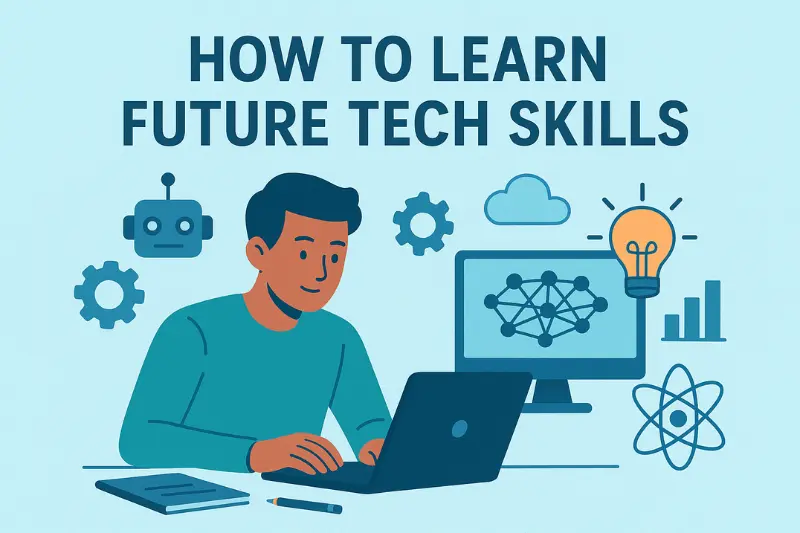
Learning future tech skills doesn’t have to feel overwhelming. By following a structured approach, you can steadily build expertise and stay competitive in today’s fast-changing digital world.
Identify Your Area of Interest
Explore different tech domains—AI, Data Science, Cybersecurity, Cloud, Blockchain, etc.—and choose one that matches your passion, career goals, or industry needs.
Start with the Basics
Before diving into advanced topics, build a strong foundation in computer science, mathematics, and problem-solving. Free resources like YouTube tutorials or beginner-friendly platforms (Coursera, Udemy, Khan Academy) are a great place to start.
Take Online Courses & Certifications
Enroll in structured courses and certification programs (AWS, Google Cloud, CEH, TensorFlow, etc.) to gain hands-on experience and validate your skills.
Practice Through Projects
Apply your learning to real-world projects—such as creating a chatbot, analyzing datasets, or developing a simple IoT prototype. Building a project portfolio strengthens both knowledge and employability.
Join Tech Communities & Forums
Engage with like-minded learners and professionals on platforms like GitHub, Stack Overflow, Reddit, and LinkedIn groups. Networking exposes you to new ideas and collaboration opportunities.
Stay Updated with Trends
Tech evolves rapidly—follow blogs, podcasts, and news sources to keep up with the latest breakthroughs in your chosen field.
Build a Career Path
Once you’ve gained confidence, apply for internships, freelance projects, or entry-level roles to gain practical experience. Over time, specialize further or branch into related technologies.
Keep Practicing & Upskilling
Future tech skills aren’t “one-time learning.” Continuous practice and upgrading your knowledge ensure long-term growth and adaptability.
Industries That Demand Future Tech Skills
Information Technology & Software
The IT sector is the backbone of digital transformation. With the rise of AI-powered applications, cloud-native development, and DevOps practices, companies are streamlining workflows and delivering faster, more reliable services. Cybersecurity has also become a must-have skill to protect data and applications in an increasingly connected world. IT professionals with these future-ready skills enjoy global opportunities in startups, enterprises, and remote freelancing.
Finance & Banking
Financial institutions are adopting blockchain for secure transactions, AI algorithms for fraud detection, and big data analytics for customer insights. Mobile wallets, digital currencies, and automated trading platforms are reshaping how we manage money. As fintech disrupts traditional banking, professionals with skills in blockchain, cybersecurity, and data science are in especially high demand.
Healthcare & Biotechnology
Technology is revolutionizing healthcare—from robot-assisted surgeries to AI-driven diagnostics that detect diseases early. IoT-enabled wearables track patient health in real time, while data science helps create personalized treatment plans. Biotechnology also leverages machine learning and big data for drug discovery and genome research. Professionals who blend tech with healthcare knowledge are driving this life-saving innovation.
Manufacturing & Supply Chain
The rise of Industry 4.0 has transformed manufacturing with smart factories powered by IoT, robotics, and automation. Sensors and predictive analytics reduce downtime, while AI optimizes production efficiency. In supply chains, blockchain ensures transparency, while drones and robotics streamline logistics. Future tech skills help professionals adapt to these smart, interconnected systems.
Retail & E-Commerce
Retailers are using AI chatbots, personalized recommendation engines, and AR/VR shopping experiences to improve customer engagement. Big data analytics helps predict demand and manage inventory, while automation speeds up supply chain operations. Those skilled in data science, AR/VR development, and AI tools are shaping the future of digital shopping.
Education & E-Learning
The education sector has shifted rapidly toward digital learning. AI tutors provide personalized feedback, VR classrooms offer immersive learning, and e-learning platforms give students access to global knowledge. Teachers and trainers with skills in edtech, content creation, and AI integration can make education more engaging, scalable, and accessible worldwide.
Energy & Environment
As the world moves toward sustainability, technologies like IoT sensors, big data, and quantum computing are improving energy efficiency and renewable resource management. Smart grids, AI-driven energy forecasting, and digital twins are helping organizations reduce carbon footprints. Professionals skilled in these technologies are contributing directly to solving global environmental challenges.
Government & Defense
Governments and defense organizations are adopting AI for surveillance, blockchain for secure data management, and cybersecurity solutions to protect critical infrastructure. Drones, robotics, and advanced simulations are being deployed for both defense and disaster management. Skilled professionals in these areas play a vital role in safeguarding nations and ensuring public service efficiency.
The Role of Lifelong Learning in Staying Relevant
In a world where technology evolves faster than ever, the traditional idea of “learning once and working for life” no longer applies. Today, skills can become outdated within a few years—or even months—due to rapid innovation. This makes lifelong learning a critical mindset for anyone who wants to stay relevant in the tech-driven economy.
Lifelong learning goes beyond formal education. It involves consistently upskilling and reskilling through online courses, workshops, certifications, peer learning, and hands-on projects. By adopting a growth mindset, professionals can adapt to emerging technologies such as AI, blockchain, IoT, and cloud computing.
Why Lifelong Learning Matters
- Keeps Skills Updated: Ensures you remain competitive in a changing job market.
- Boosts Career Growth: Opens opportunities for promotions, new roles, and cross-industry shifts.
- Builds Adaptability: Makes it easier to pivot careers when industries are disrupted.
- Encourages Innovation: Continuous learning fosters creativity and problem-solving in real-world scenarios.
Lifelong learners don’t just survive technological change—they thrive in it. By staying curious, adaptable, and proactive, professionals can future-proof their careers and remain valuable contributors in any industry.
FAQs About Future Tech Skills
What are future tech skills?
Future tech skills are technical and digital competencies that are expected to be in high demand as technology evolves. Examples include AI & Machine Learning, Data Science, Cybersecurity, Blockchain, Cloud Computing, IoT, AR/VR, and Quantum Computing.
Why are future tech skills important?
These skills help professionals stay relevant in a rapidly changing job market, access higher-paying jobs, and contribute to innovation across industries. They are crucial for career growth and adaptability in a tech-driven world.
How can I start learning future tech skills?
Begin by identifying your area of interest, taking online courses, practicing through projects, joining tech communities, and earning relevant certifications. Platforms like Coursera, Udemy, edX, and LinkedIn Learning are great starting points.
Are future tech skills only for IT professionals?
No. Many industries—from healthcare and finance to manufacturing and retail—demand tech-savvy professionals. Even non-technical roles benefit from digital literacy and basic knowledge of emerging technologies.
How long does it take to master these skills?
It depends on the complexity of the technology and the learner’s dedication. Foundational knowledge can take a few months, while mastery may require 1–2 years of continuous learning and hands-on practice.
What are the best certifications for future tech skills?
Certifications vary by field. Examples include:
AI & ML: TensorFlow, Microsoft AI, Google AI
Cloud Computing: AWS Certified Solutions Architect, Azure Fundamentals
Cybersecurity: CEH, CISSP, CompTIA Security+
Data Science & Big Data: IBM Data Science Professional, Google Data Analytics
Blockchain: Certified Blockchain Developer, Hyperledger Fabric
Can learning these skills guarantee a job?
While no skill can guarantee employment, acquiring future tech skills significantly improves your employability and opens doors to high-demand career paths globally. Combining technical skills with digital soft skills increases your chances even further.
How do I stay updated with the latest tech trends?
Follow tech blogs, podcasts, newsletters, LinkedIn influencers, and communities like GitHub or Stack Overflow. Participating in webinars, workshops, and hackathons also helps you stay current.
Final Thoughts: Preparing Yourself for the Future of Work
The future of work will be defined by rapid technological change, automation, and digital transformation. To stay ahead, professionals must embrace a mindset of continuous learning and proactively acquire future tech skills like AI, Data Science, Cybersecurity, Cloud Computing, IoT, and Blockchain.
Equally important are digital soft skills—communication, adaptability, collaboration, and critical thinking—that complement technical expertise and make you a well-rounded, future-ready professional.
By combining technical proficiency, soft skills, and a commitment to lifelong learning, you not only secure career opportunities but also position yourself as an innovator and problem-solver in a tech-driven world.
Invest in your learning today, apply your knowledge through projects and real-world experience, and stay curious. The future favors those who prepare for it—so start building the skills that will define tomorrow’s workforce.
Digital Marketing Internship – Kickstart Your Career
Best Digital Marketing Agency – Grow Your Business Fast
