

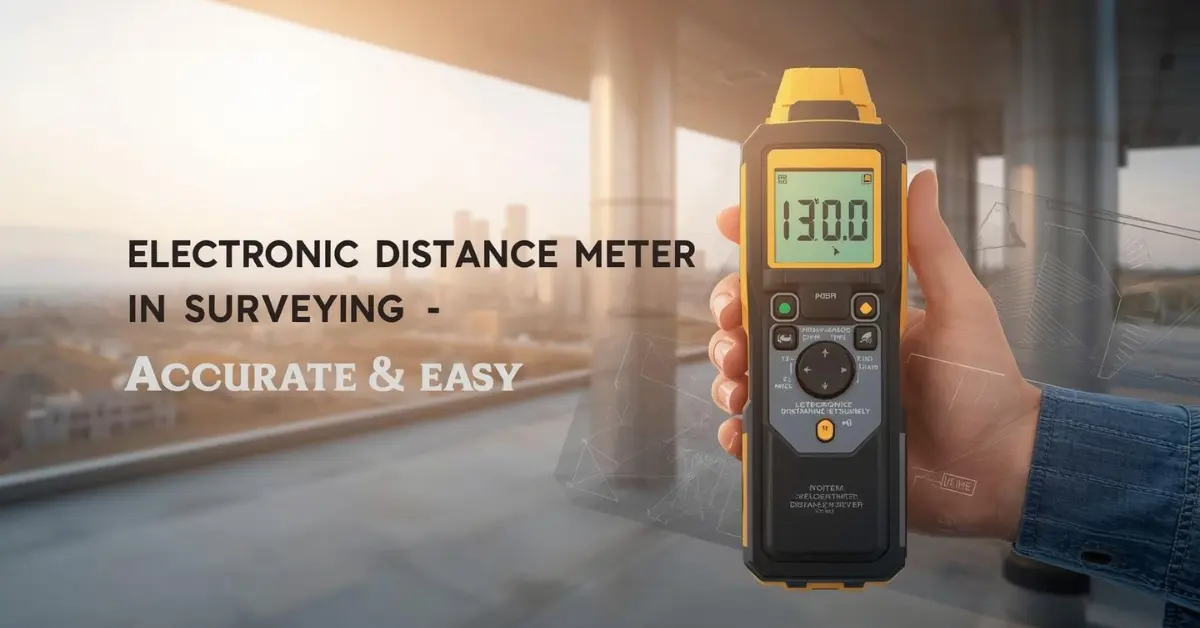
Introduction to Electronic Distance Meters (EDMs)
Imagine standing in the middle of a vast construction site, sun blazing overhead, trying to measure hundreds of meters of uneven terrain with just a tape measure. Frustrating, right? That’s exactly the kind of challenge surveyors faced before the rise of modern technology. Enter the Electronic Distance Meter in surveying a device that has completely transformed how distances are measured in the field.
An EDM is an instrument that calculates the distance between two points using electromagnetic waves, usually laser or infrared. Instead of dragging chains or tapes across rough ground, a surveyor can now get precise readings in seconds. It’s not just faster it’s more accurate, less physically demanding, and far less prone to human error.
Think about it: with a traditional tape, even a tiny misstep or a slope can skew your results. But with an EDM, those millimeter-level errors are minimized, allowing surveyors to focus on analysis and planning rather than tedious measuring. Whether you’re mapping a new urban development or checking boundary lines for a rural plot, EDMs have become indispensable tools in modern surveying.
Table of Contents
How an EDM Works
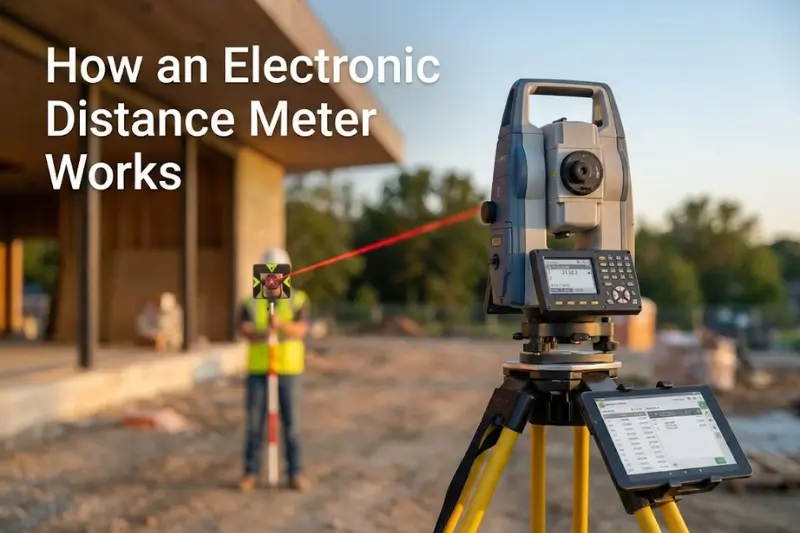
At its core, an Electronic Distance Meter in surveying is surprisingly elegant. It measures the distance between two points using either a laser or infrared signal. Essentially, the device sends out a beam toward a target, which then reflects it back. By calculating the time it takes for the signal to return, the EDM can determine the exact distance often down to a few millimeters.
It’s a bit like playing catch with light. The EDM “throws” the beam, waits for it to bounce back, and does the math instantly. No human guesswork, no stretching out a tape measure across mud, and no worries about uneven terrain affecting results.
This is a huge step up from traditional tools. With chains or tape measures, even a small slope, loose end, or human error can introduce inaccuracies. A 100-meter tape measurement could easily be off by several centimeters enough to cause major issues when plotting land boundaries or preparing construction layouts. EDMs eliminate most of these variables, giving surveyors reliable, repeatable results every time.
Here’s a practical observation from fieldwork: a colleague once used a tape to measure a sloped hillside for a small plot and ended up redoing the measurements twice because the slope threw off the numbers. Later, switching to an EDM cut the measurement time in half and provided precise data that could go straight into mapping software. That’s the kind of efficiency that makes these devices indispensable today.
May be you like it:
Technology for Blind People – Education to Daily Life
Tech News Top App – Stay Updated with Latest Tech Trends
Future Tech Solutions – Shaping the Digital Era
Types of EDMs
When it comes to Electronic Distance Meters in surveying, not all devices are created equal. Depending on your project, terrain, or precision requirements, different types of EDMs can make your work easier or more complicated if you pick the wrong one. Let’s break down the main types:
Total Station EDMs
Total stations combine an EDM with an angular measurement tool, allowing surveyors to measure distances and angles simultaneously. They’re widely used in topographic surveys, construction layouts, and large-scale mapping.
Pros:
- High accuracy over long distances.
- Integrated angle measurements save time.
- Can interface directly with mapping software.
Cons:
- Bulky and heavier than handheld options.
- Expensive upfront cost.
- Requires some training to operate efficiently.
Think of it as the all-in-one professional tool powerful, precise, but not exactly pocket-sized.
Reflectorless EDMs
These devices don’t require a prism or reflector to measure distance. They send a signal directly to the target and measure the reflected beam. Reflectorless EDMs are particularly useful in urban environments, rough terrain, or areas where placing a reflector is impractical.
Pros:
- Can measure inaccessible or hard-to-reach points.
- Reduces setup time in tricky terrain.
- Great for construction and engineering projects where obstacles are common.
Cons:
- Slightly lower accuracy compared to prism-based EDMs over long distances.
- Environmental factors like heavy rain or fog can affect measurements.
Handheld / Laser EDMs
Handheld EDMs are small, portable, and easy to use. While they may not have the extreme precision of total stations, they’re ideal for smaller plots, indoor surveys, or quick field checks.
Pros:
- Lightweight and portable.
- User-friendly minimal training required.
- Affordable compared to full total stations.
Cons:
- Limited range and slightly less accuracy for large-scale projects.
- Fewer advanced features than total stations.
Advantages of Using EDMs in Surveying
Using an Electronic Distance Meter in surveying isn’t just about modernizing the tools it’s about transforming the way surveyors work. From cutting down fieldwork time to improving accuracy, the benefits are tangible and game-changing.
Speed
One of the biggest advantages is how fast measurements can be taken. Instead of stretching tapes over uneven ground or climbing hills to align chains, an EDM provides precise readings in seconds. For example, a survey team measuring a large plot that would normally take half a day with traditional methods can now finish in under an hour. That’s not just efficiency it’s freeing up time for analysis, planning, and problem-solving.
Accuracy
Accuracy is where EDMs truly shine. Modern devices can measure distances down to a few millimeters, even over several kilometers. In real-world terms, this precision prevents costly errors in construction, boundary mapping, and topographic surveys. A miscalculation of just a few centimeters in urban planning can lead to structural problems something surveyors can now avoid with confidence.
Ease of Use
Many EDMs are designed with user-friendliness in mind. Digital displays, intuitive controls, and automated calculations mean even junior surveyors can get reliable results quickly. In one field observation, a student surveyor with minimal experience was able to perform accurate measurements in less than half the time it would have taken manually proving that these tools democratize precision.
Data Integration
Most modern EDMs can connect directly to software, allowing data to be imported into mapping, CAD, or GIS systems instantly. This integration reduces manual transcription errors and streamlines the workflow from field measurement to project planning. Imagine finishing a survey and having the data ready to use immediately, rather than spending hours entering numbers into a computer.
Applications in Real-World Surveying
The practical value of an Electronic Distance Meter in surveying shines brightest when you see it in action. Surveyors across industries rely on EDMs to tackle tasks that were once tedious, time-consuming, or downright frustrating.
Land Surveying
Land boundaries need to be exact, and even a small miscalculation can lead to disputes or legal complications. EDMs allow surveyors to measure property lines quickly and accurately, even over uneven terrain or long distances. Unlike traditional chains or tapes, which can sag or shift, an EDM ensures precise measurements every time.
Topography
Mapping the contours of a site used to require a lot of climbing, stretching, and cross-checking measurements. With EDMs, surveyors can capture accurate distances and angles from a single location, creating detailed topographic maps without physically covering every inch of the land. It’s like having a bird’s-eye view without leaving the ground.
Construction Layout
Construction projects demand precise measurements for foundations, roads, and infrastructure. EDMs help surveyors mark exact points for excavation or installation. A single misaligned measurement could delay a project or cause structural issues, but EDMs minimize these risks by providing reliable data instantly.
Urban Mapping
In crowded cities, reflectorless EDMs are particularly useful. Buildings, traffic, and obstacles often make traditional surveying methods impractical. EDMs can measure distances to hard-to-reach points safely and efficiently, enabling accurate urban planning and infrastructure development.
Key Features to Consider When Choosing an EDM
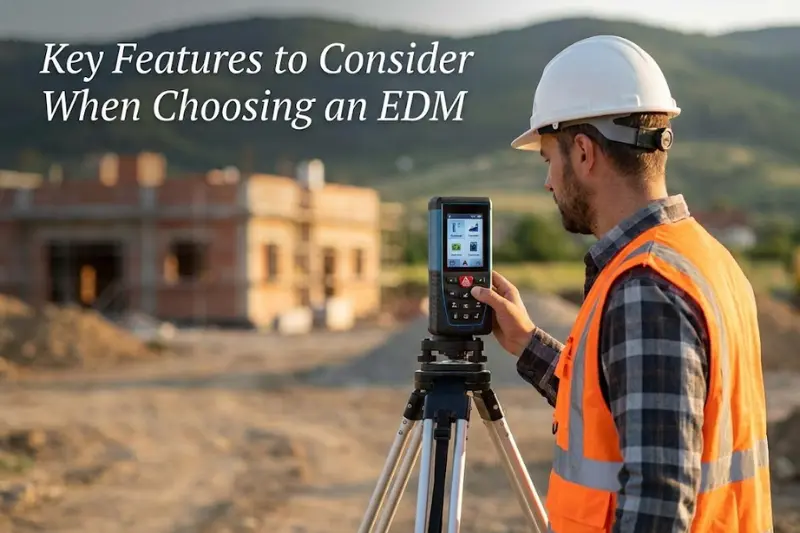
Choosing the right Electronic Distance Meter in surveying isn’t just about picking the newest model on the shelf. The right device can save hours of work, reduce errors, and make your fieldwork much smoother. Here are the key features to keep in mind:
Measurement Range
Different projects require different ranges. Some handheld EDMs are perfect for small plots or indoor work, while total station EDMs can measure distances over several kilometers. Make sure the device you choose fits the scale of your projects otherwise, you might end up taking multiple trips or combining devices unnecessarily.
Accuracy
Accuracy is the heartbeat of surveying. Even minor errors can compound and cause major discrepancies. Check the specifications carefully: high-precision EDMs can measure down to millimeters, which is essential for boundary surveys or construction projects where exact measurements matter.
Portability
Fieldwork can be exhausting, especially if you’re carrying heavy equipment across rough terrain. Handheld or compact EDMs are easy to transport, while larger total stations may require tripods and careful setup. Think about the balance between functionality and convenience for your specific use case.
Battery Life
A surveyor stranded with a dead EDM is not a happy surveyor. Devices with long-lasting batteries or quick-swap options keep your fieldwork uninterrupted. Some advanced EDMs even allow charging in the field using portable power banks a small feature that can make a huge difference during long days outdoors.
Software Compatibility and Field Usability
Modern EDMs often connect directly to mapping or CAD software, reducing manual data entry and minimizing errors. Check if the device supports the software you use and whether it offers features like real-time data transfer. Field usability also matters: intuitive menus, clear displays, and ergonomic design make a long day of surveying much more manageable.
May be you like it:
Which B.Tech Course is Best for Future – Career Guide
MPA Nashik e Learning – Online Police Training Platform
SBI e Learning – Online Training & Employee Courses
Practical Tips for Using an EDM Efficiently
Owning an Electronic Distance Meter in surveying is one thing using it effectively in the field is another. Even the best device can deliver inaccurate results if you overlook a few practical considerations. Here are some tips to get the most out of your EDM:
Ensure a Clear Line of Sight
EDMs rely on a direct path between the device and the target. Trees, buildings, or uneven terrain can interfere with measurements. Before taking a reading, check that nothing is obstructing the signal. Sometimes, a small adjustment in position can save a lot of frustration.
Reflective question: Have you ever taken a measurement only to realize later that a tiny obstacle skewed the result?
Regular Calibration
Calibration isn’t optional it’s essential. Even a small misalignment in the device can affect readings over long distances. Make a habit of checking and calibrating your EDM before heading into the field. Think of it as giving your tool a quick health check to ensure accuracy.
Mind Environmental Conditions
Weather matters. Heavy rain, fog, or dust can impact some EDMs, particularly reflectorless models. High heat can also cause slight errors due to air refraction. Planning your measurements for favorable conditions can make a big difference in reliability.
Use Digital Data Recording
Many EDMs allow direct export to software, which reduces manual transcription errors. Always take advantage of this feature whenever possible. Not only does it save time, but it also ensures that your data is ready for immediate analysis or mapping.
Pro tip from the field: One survey team I observed kept meticulous digital records on-site. Later, they could cross-reference past measurements instantly, avoiding repeated trips and saving hours of labor.
Common Mistakes to Avoid When Using an EDM
Even the most advanced Electronic Distance Meter in surveying can deliver inaccurate results if you’re not careful. Many errors aren’t due to the device itself, but rather how it’s used in the field. Being aware of these pitfalls can save time, frustration, and costly rework.
Skipping Calibration
Calibration might feel like a small chore, but skipping it is a common mistake. Even slight misalignments in the EDM can lead to significant measurement errors, especially over long distances. Make calibration a routine part of your field setup think of it as tuning a musical instrument before a performance.
Ignoring Terrain or Weather Factors
Uneven ground, slopes, heat waves, fog, or dust can all affect the accuracy of an EDM. Surveyors sometimes rush into measurements without considering these environmental factors. Always assess the site conditions and adjust your setup as needed it’s often the difference between a reliable measurement and a repeat trip.
Relying on a Single Measurement
Even with a high-precision EDM, taking just one reading can be risky. Repeating measurements and cross-checking results ensures reliability. In practice, a surveyor might take three readings of the same distance and use the average to reduce the chance of anomalies.
EDM vs Traditional Surveying Methods
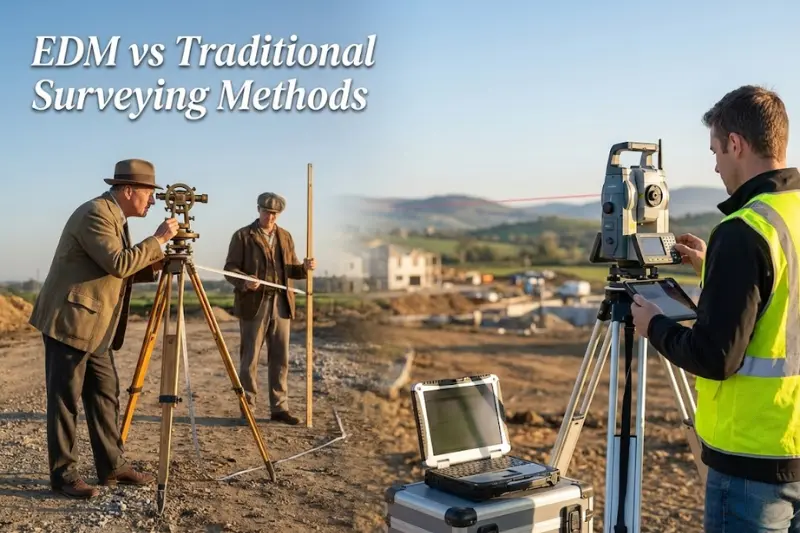
Surveying has come a long way from chains, tapes, and manual calculations. Comparing an Electronic Distance Meter in surveying to traditional methods highlights exactly why modern surveyors rarely go back.
Speed
Traditional tools require physically stretching tapes, aligning chains, and carefully marking points a process that can take hours for a moderately sized plot. With an EDM, the same measurements can be completed in minutes. For instance, measuring a hillside that would normally take a team an entire day with tapes can now be done in a few hours, leaving more time for analysis and planning.
Accuracy
Even the most careful tape measurement can be affected by slope, sag, or human error. EDMs deliver consistent results with millimeter-level precision, making them essential for projects where accuracy is non-negotiable, such as boundary verification or construction layout.
Effort
Let’s face it: dragging heavy tapes across rough terrain is physically demanding. EDMs reduce this effort dramatically. Surveyors can focus on interpreting data and planning next steps rather than on repetitive manual work.
Why EDMs Are Essential
EDMs combine speed, precision, and convenience in a way traditional tools simply can’t match. They integrate seamlessly with digital mapping and CAD software, reduce human error, and make surveying safer especially in difficult terrain or urban environments. For modern surveying, they aren’t just helpful; they’re indispensable.
FAQs About Electronic Distance Meters in Surveying
What is an Electronic Distance Meter (EDM)?
An EDM is a surveying instrument that measures the distance between two points using laser or infrared signals. It’s faster, more accurate, and less labor-intensive than traditional tape or chain methods.
How accurate are EDMs?
Most modern EDMs can measure distances with millimeter-level precision, even over several kilometers. Accuracy depends on the type of EDM and environmental conditions, but it’s far superior to manual measurement tools.
Can EDMs be used without a prism?
Yes, reflectorless EDMs can measure distances without a prism. These are particularly useful in urban areas or rough terrain where placing a reflector is difficult.
How do EDMs compare to traditional surveying methods?
EDMs are much faster, reduce human error, and are easier to integrate with digital mapping or CAD software. Traditional tools still work for small or low-budget projects, but EDMs are preferred for precision and efficiency.
What factors should I consider when choosing an EDM?
Key considerations include measurement range, accuracy, portability, battery life, and software compatibility. Field usability and environmental conditions also play a big role in performance.
Conclusion & Future Outlook
The Electronic Distance Meter in surveying has fundamentally changed how surveyors work. By combining speed, accuracy, and convenience, EDMs reduce human error, save time, and make fieldwork far more efficient. From land surveying and construction layouts to urban mapping, these devices have become indispensable tools in the modern surveyor’s toolkit.
Looking ahead, EDM technology continues to evolve. Integration with drones, GPS, and GIS systems is already making measurements even faster, more precise, and easier to analyze. Imagine conducting a topographic survey from the air, feeding data directly into mapping software the possibilities are expanding every year.
May be you like it:
Digital Marketing Internship – Kickstart Your Career
Best Digital Marketing Agency – Grow Your Business Fast
